Newsletter - Edition 68 - April 2025

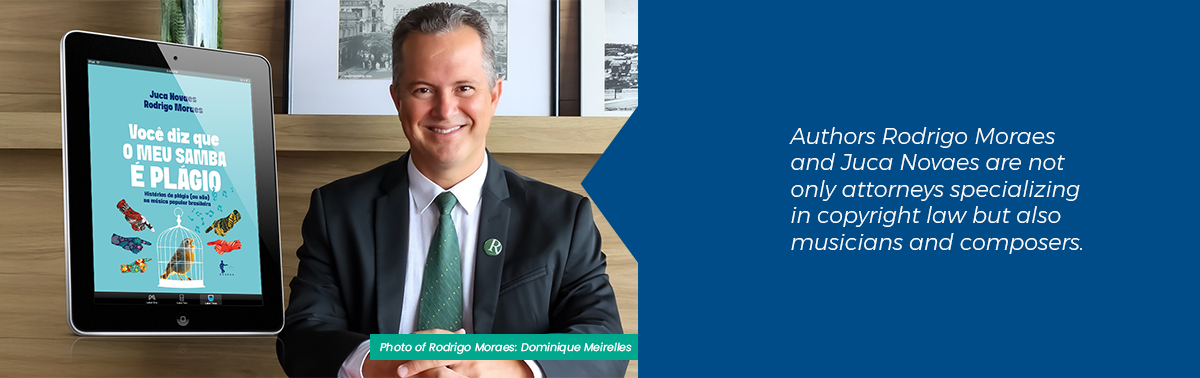
The ABPI’s Regional Representative in Bahia, Rodrigo Moraes, has many stories to tell about plagiarism in Brazilian popular music (MPB). Alongside Juca Novaes, he co-authored the book Você diz que meu samba é plágio, published by EDUFBA. As the title suggests, the work is not a technical manual filled with legal jargon but rather a collection of stories—an accessible and relaxed narrative about copyright infringement in music. The authors, both practicing attorneys specializing in copyright law, are musicians and composers with recorded albums and deep knowledge of music theory. In this interview, Moraes shares some of the stories they uncovered during two years of research.
What sparked your interest in writing the book?
Rodrigo Moraes:
We aimed to educate while also entertaining through the narration and analysis of more than eighty curious cases of plagiarism—or false accusations of plagiarism. We wanted to bring key copyright concepts out of the academic sphere and into an accessible conversation with anyone interested in music and culture. Juca and I are not only specialists in Copyright Law but also musicians and composers who have albums available on streaming platforms. Our ability to read sheet music and understand music theory gives us greater discernment when analyzing plagiarism cases, which we often encounter in our legal practice.
How was the research conducted, and what sources did you use?
RM:
We drew on various sources: judicial decisions, legal treatises, biographies, books on the history of Brazilian popular music, news articles, the National Library’s digital archive, and interviews with composers, among others. It was an interdisciplinary research process that spanned over two years. It was a tremendous learning experience, and we are now sharing the results with readers.
How serious is the plagiarism issue in MPB?
RM:
There’s still a lot of misinformation, both in legal and musical circles. Brazil has more than 1,800 law schools, but very few include Copyright Law in their curricula, which shows just how far behind we are—especially considering that intangible property is the most valuable asset of this century. Similarly, music schools unfortunately also tend not to teach basic concepts of copyright and related rights, which are crucial for the professional work of musicians, composers, arrangers, and performers. Some myths still need to be debunked, like the old eight-bar myth that claims plagiarism only exists when more than eight musical bars are copied—an inaccuracy that continues to be repeated. The book also offers guidance for musicians who may wish to serve as expert witnesses in judicial cases involving allegations of musical plagiarism. It is common for judges to rely on expert reports prepared by music specialists, and the book can help prepare musicians to work as judicial experts or technical consultants in these types of disputes.
What are some of the most famous cases of plagiarized songs?
RM:
There are many interesting cases, even where the defense claimed the plagiarism was unintentional, with no deliberate intent to copy. For instance, we recount the case of Da Ya Think I’m Sexy? by Rod Stewart, whose chorus is strikingly similar to that of Taj Mahal by Jorge Ben Jor. At the time, the case received extensive media coverage. However, we did not aim to provide definitive legal opinions on each story narrated in the book. We leave the final judgment to the readers.
What percentage of those alleging plagiarism pursue legal action?
RM:
Not every plagiarism accusation results in a lawsuit. Many remain in the realm of controversy. In the book, we demonstrate that there have been many unfounded allegations over time. We also recount cases where lawsuits were filed but ended with judgments in favor of the accused.
Does the Brazilian Copyright Law adequately protect authors against plagiarism?
RM:
Interestingly, the term plagiarism does not appear in the Brazilian Copyright Law (Law No. 9,610/1998). Nor did it appear in previous legislation such as the Medeiros e Albuquerque Law (Law No. 496/1898), the Civil Code of 1916, or the previous Copyright Law of 1973. This absence is intentional. It is not the role of legislators to define plagiarism. Rather, plagiarism is considered an open, indeterminate concept, requiring the judge to evaluate each case individually. Judges must consider all the factual details presented: the creation and registration dates (if applicable) of each work, the testimony of the parties and witnesses to determine if the alleged plagiarist had access to the original work, expert reports providing contrastive analyses, documentary evidence such as handwritten drafts by the original author, the degree of originality of the works involved, and so forth.
Has the internet exacerbated the plagiarism problem?
RM:
Yes. But musical plagiarism and plagiarism accusations long predate the internet. With the rise of digital platforms, composers have become increasingly invisible. Until very recently, users of music streaming services often could not even find information about the authors of the songs they were listening to. This not only violated the Copyright Law (Law No. 9,610/1998) but also infringed upon consumers’ right to information, as outlined in the Consumer Protection Code. Today, composers face new challenges, such as securing fair remuneration in the digital environment and preventing the parasitic appropriation of their creations by generative artificial intelligence companies.
Are false accusations of plagiarism common in MPB? What causes them?
RM:
There have been some remarkable cases of frivolous lawsuits based on false plagiarism claims. One particularly absurd case was brought before the Court of Justice of the State of Bahia against the talented composers of the Minas Gerais-based group Skank. It was an egregious act of bad faith, worsened by irresponsible media coverage from a major news outlet, which publicized the accusation without observing the presumption of innocence. False plagiarism accusations can severely damage an artist’s reputation. The members of Skank ultimately won the lawsuit—but it took 23 years to reach a final judgment. The band had already ended its career before the case was resolved. We were fortunate to obtain an exclusive statement from one of the main defendants for inclusion in the book.