Newsletter Edition 84 – September 2026

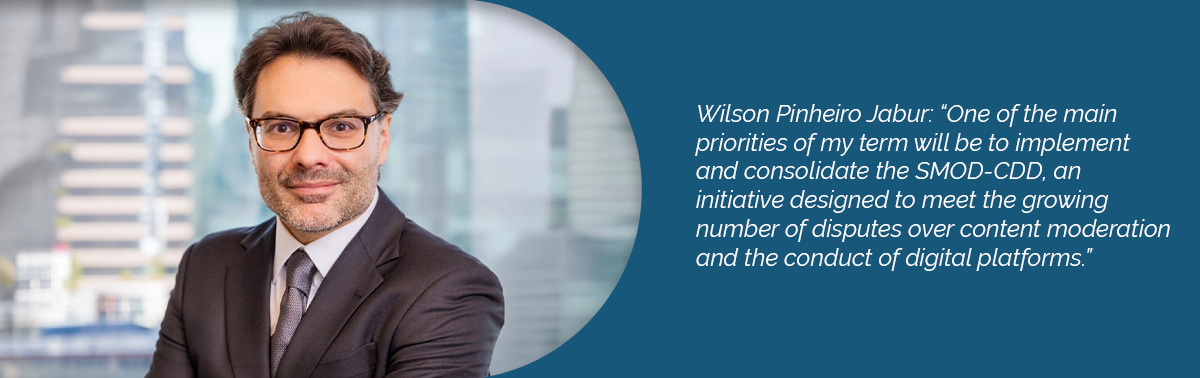
Experience is something attorney Wilson Pinheiro Jabur has in abundance. He has just taken over as President of the ABPI Intellectual Property Dispute Resolution Center (CSD-ABPI), chosen unanimously to succeed Manoel J. Pereira dos Santos, and he arrives with the familiarity of someone who has long been at the heart of IP disputes. A registered Industrial Property Agent, an arbitrator and mediator at WIPO and at the CSD-ABPI itself, and a panelist at international centers such as the MFSD Srl – IP Mediation and Arbitration Center and the Asian Domain Name Dispute Resolution Centre (ADNDRC), Jabur brings a career that combines practice, research and teaching. A professor at FGV Direito SP and other leading institutions, he steps into his new role with well-defined plans. In this interview, he previews what he intends to put in place at the helm of the Center.
What will be the main priorities of your term at the helm of the CSD-ABPI?
Wilson Pinheiro Jabur: I take on the presidency of the CSD-ABPI committed to preserving its greatest asset: the credibility built over the past 15 years, grounded in the independence of its experts, the technical quality of its decisions and the trust of its users. At the same time, I believe this is an important moment for the CSD-ABPI to take new steps.
One of the main priorities of my term will be the implementation and consolidation of the new Online Digital Disputes Moderation System, the SMOD-CDD, developed within the Digital Law Chamber. It responds to a very concrete reality: the growth in disputes over content moderation and the conduct of digital platforms, and the need for independent, specialized and efficient mechanisms to resolve them.
The SMOD-CDD was designed to work as a second layer of review, complementing platforms’ internal mechanisms and providing independent expert analysis in situations involving more complex legal or technical questions. This model opens a highly significant new front for the CSD-ABPI and, at the same time, reinforces its vocation for developing specialized solutions in areas where speed and technical knowledge are particularly important.
In parallel, we will continue to refine our well-established procedures, especially the SACI-Adm; to train and renew our roster of experts; and to broaden dialogue with users, institutions and other stakeholders in the community.
After more than 15 years of the SACI-Adm, which aspects of the system do you believe deserve improvement to make it even more efficient and predictable?
WPJ: The SACI-Adm is an extremely successful experience in administrative dispute resolution in Brazil, as its numbers show, along with the negligible percentage of cases later taken to court.
It is essential that the Center keep its commitment to the predictability of the system without, of course, compromising the experts’ independence in assessing each case. To that end, we will always look for the best ways to make decisions easier to access and to identify consolidated positions.
At the same time, we must preserve one of the SACI-Adm’s great virtues: its ability to deliver technically sound answers swiftly.
That accumulated experience is also extremely valuable for developing new mechanisms. What we have learned from the SACI-Adm shows that it is possible to build, in Brazil, specialized dispute resolution systems that combine speed, technical quality and legal certainty. It is on this experience that we intend to build the CSD-ABPI’s new initiatives.
How does the CSD-ABPI intend to balance speed, legal certainty and technical quality in its decisions, especially given the growth and increasing complexity of disputes?
WPJ: That balance is one of the main challenges for any dispute resolution system. Speed matters enormously, but it cannot come at the expense of the quality of the decision or of the safeguards owed to the parties.
At the CSD-ABPI, quality starts with the selection and training of experts and extends to clear procedures, efficient case administration and adequate conditions for each dispute to receive the depth of analysis it truly requires. The very creation of the SMOD-CDD rests on this premise. Some digital disputes can be resolved through platforms’ internal mechanisms, but others involve a legal or technical complexity that calls for specialized, independent analysis.
The role of a mechanism such as the SMOD is precisely to provide that additional layer when needed, whether after internal mechanisms have been exhausted or when the platform itself refers a matter that does not fit its ordinary workflows or raises a reasonable doubt requiring qualified diligence.
So I see speed not as simply deciding faster, but as the ability to eliminate unnecessary steps and direct each dispute to the most appropriate procedure and level of analysis. Efficiency, legal certainty and technical quality must be treated as complementary values, not mutually exclusive ones.
Training new experts has always been a concern for the IP community. Are there plans to expand initiatives for training, diversity and renewal of the CSD-ABPI’s roster of experts?
WPJ: An institution like the CSD-ABPI must both value the accumulated experience of its experts and create opportunities for a new generation of professionals to emerge.
Training and technical development initiatives are already planned, along with an expansion of the roster aimed at diversity of professional experience, generations, regions, backgrounds and perspectives. The more diverse and technically qualified our roster of experts, the better equipped the CSD-ABPI will be to respond to the wide range of disputes submitted to it.
Renewal, however, must be done responsibly. The aim is not simply to increase the number of experts, but to identify, train and prepare professionals who are truly ready for a role that demands technical knowledge, independence, balance and availability.
New procedures such as the SMOD-CDD make this concern even more pertinent, because they also broaden the body of knowledge our experts need. Beyond intellectual property in the traditional sense, we must be prepared for issues involving digital platforms, content moderation, privacy, data protection, personality rights and other matters at the intersection of law and technology.
Another important part of this picture is the Moot, now in its fifth edition, which helps build a culture of IP arbitration among new professionals. This model will be maintained and, possibly, intensified.
What message would you like to share with the IP community about the future of the CSD-ABPI and the institution’s role in consolidating appropriate dispute resolution methods in Brazil?
WPJ: The main message is continuity with evolution. The CSD-ABPI has built a position of credibility in IP dispute resolution, and I have been entrusted with the responsibility of preserving that legacy. I intend to do so by keeping the Center a living institution, able to respond to changes in society, in technology and in the very forms conflict takes.
The launch of the SMOD-CDD is the first proof of this vision: drawing on the experience the CSD-ABPI has accumulated, we are building an institutional response to a new generation of disputes, tied to digital platforms, content moderation and other conflicts of the digital environment.
I reaffirm my commitment to having the CSD-ABPI recognized as Brazil’s leading center of reference for resolving intellectual property and digital law disputes, one that combines independence, technical excellence, innovation and legal certainty, honoring the experience built so far while turning it toward the disputes that lie ahead in the coming years.