Newsletter - Edition 67 - March 2025

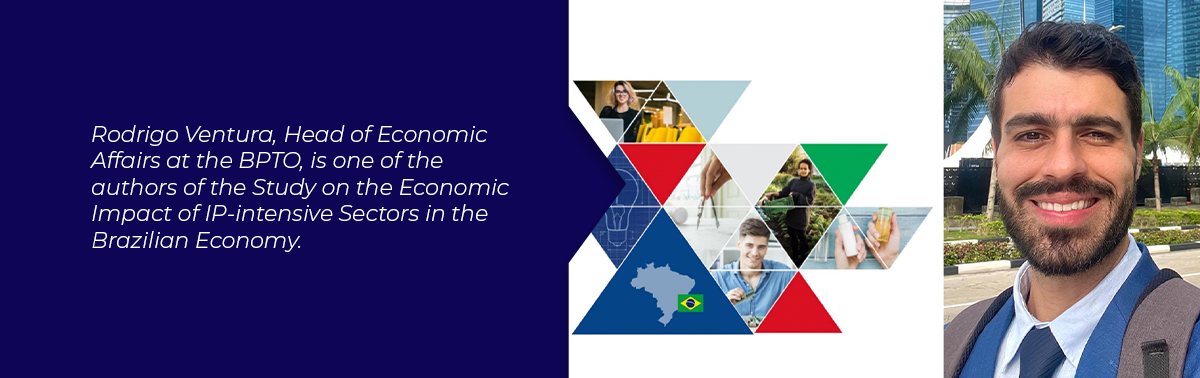
Which sectors in Brazil make intensive use of Intellectual Property Rights (IPRs), and what is their actual contribution to the country’s economy? To answer this question, a team of ten professionals from IP Key Latin America (a project led by the European Commission and implemented by the European Union Intellectual Property Office – EUIPO), Brazil’s Ministry of Development, Industry, Commerce and Services (MDIC), the BPTO, and the consultancy firm Analytica, conducted year-long research. The result is the Study on the Economic Impact of IP-intensive Sectors in the Brazilian Economy, co-authored by BPTO economist Rodrigo Ventura, who discusses its findings in this interview.
What stands out most in the study? What conclusions can be drawn compared to the previous three-year period?
Rodrigo Ventura: Overall, IP-intensive sectors have increased their share in employment and income generation in Brazil compared to the previous period. Between 2020 and 2022, industries that make intensive use of IP employed, on average, 22.6 million people annually—approximately 40% of the employed population during that time. The wage premium in IP-intensive sectors averaged 4.9% in the same period. Specifically, workers in patent-intensive sectors received a wage premium of 64%.
How does the study define and measure an IP-Intensive Sector?
RV: IP-intensive sectors are defined as those with sevral IPR registrations per average number of employed individuals above the national average, as compared to other sectors that use IPRs. Of the 669 sectors in the Brazilian economy classified at the 5-digit level of the National Classification of Economic Activities (CNAE 2.3), 461 were identified as IP-intensive between 2017 and 2022. Of these, 54% are intensive in more than one type of IPR.
Is there a direct relationship between IP intensity and the economic strength of these sectors?
RV: Absolutely. Sectors that invest more heavily in IP tend to be more adaptable to market changes, more innovative in terms of products and services, and more operationally efficient. This translates into higher competitiveness, greater resilience amid crises, and stronger economic performance. In international trade, IP-intensive industries represented 63.3% of Brazil’s exports of goods and services from 2020 to 2022.
How can the economic importance of these sectors be measured?
RV: These sectors contributed more than half (50.2%) of Brazil’s GDP between 2020 and 2022, totaling BRL 3.76 trillion. IP-intensive industries were responsible for 64% of exports and 84% of imports, underscoring their central role in the country’s trade balance. Their economic relevance also plays out at the regional level. Many Brazilian states, especially those farther from major urban centers, have adopted Geographical Indications (GIs) to promote traditional products with export potential. For instance, approximately 93% of jobs in the coffee sector are in companies whose products benefit from GIs.
How will the study’s findings be used by the BPTO to shape economic policy?
RV: Despite their importance, the extent and impact of IPRs on the economy are still poorly understood due to the scarcity and outdated nature of available data – especially in emerging countries like Brazil. This study helps address that gap by providing policymakers, business leaders, and academics with up-to-date information on how sectors that rely on IP protection contribute to national economic performance.
What did the study reveal about green patents?
RV: Sectors that make intensive use of green patents demonstrated remarkable productivity. Their contribution to GDP nearly tripled between the 2017–2019 and 2020–2022 periods. Furthermore, the average wage in green patent-intensive sectors was 30.5% higher than in non-IP-intensive sectors during the 2020–2022 period.